Tuesday, 13 November 2012

Newark Area Churches, Part One


Newark's spire is a landmark for miles


The area around Newark has several churches of real quality, including the magnificent Newark parish church, “among the two or three dozen grandest parish churches of England” (Pevsner). To do it justice we’ll have to cover that in a separate article later.  Two more wonderful churches are also close to Newark, firstly just a few miles north of the town there is the fascinating St Giles church at Holme, which we covered in an earlier article.  The other one is just south of the town, All Saints at Hawton, equally fascinating, with its chancel described by Pevsner as “one of the most exciting pieces of architecture in the country.”  Fortunately the keyholders at both Holme and Hawton live near their churches so access should not be a problem.  Anyway I’ll come back to Hawton later, as in this piece I also want to cover the churches we’ve been to in villages along the old Fosse Way south of Newark.

East Bridgford


We visited twelve of these village churches in August starting at East Bridgford, a large well kept church set on a raised churchyard high above the village street.  The church has Saxon origins though there is nothing obvious that points to its early origins on the surface.  Inside the church is neat with some interesting features including a wall memorial to John Hacker and his wife (1620), wooden angels supporting the nave roof and a number of fragments of medieval tiles set in the floor next to the altar.  Outside there are several Swithland slate gravestones in the churchyard.


Memorial to John Hacker 
East Bridgford: Wooden Angel


East Bridgford: Medieval Tiles


Kneeton
 Next was Kneeton church located in a tiny village now made even more remote following the recent dualling of the A46.  The church is plain but has a lovely setting high above the Trent valley with extensive views across the valley to the north.  More slate gravestones in the churchyard some with very poignant carvings and messages; of particular note a very sad one to Elizabeth Gilbert who died in 1815 aged 35, presumably in childbirth, with a beautifully executed if somewhat macabre carving of Death hovering over the cradle and birthing bed.

Kneeton: Sad Memorial
 North of Kneeton is East Stoke, located towards the river away from the village close to the site of the Battle of Stoke Field, where in 1487 Yorkist forces supporting the pretender Lambert Simnel were utterly routed by forces loyal to Henry VII.  The church is solid looking with a rather squat tower but light and airy inside due to the complete rebuilding of the south aisle in 1738.  Of special note are the nicely carved capitals to the chancel arch depicting foliage and fruits.  In the churchyard is a grand monument to Baron Pauncefoote, first UK ambassador to America.

East Stoke
Memorial to Baron Pauncefoote

East Stoke: Foliage and Fruit
From Stoke we crossed the newly opened dualled A46 to the tiny village of Thorpe with its church tucked away behind the former rectory.  Indeed you have to go through the front garden and driveway of the rectory to get to the church.  Quite plain and extensively restored and unfortunately locked.

Thorpe: Plain, Restored and Locked
 Then on to what was the star of the trip, All Saints at Hawton, grand outside with a glorious Decorated period east window and plenty of detail on its tower.  It is a much grander church than you would normally expect in a small village and Inside there are several unique treasures, especially the celebrated Easter Sepulchre and matching tripartite sedilia and remains of a C14 wooden rood screen.  The Sepulchre and sedilia are incredible works of complicated ornate C14 stone carving, possibly executed by the same masons who created the wonderful pulpitum screen in Southwell Minster. 

Hawton: Grand Church in a Small Village
Hawton's Glorious Easter Sepulchre

Hawton: Richly Carved Sedilia

Hawton: East Window
Easter Sepulchre: Sleeping Soldier


Sedilia: Detail

Sedilia: By the Masons of Southwell?
  
That’s Part One of this note on the Newark area.  Part Two will follow shortly.

Monday, 5 November 2012

"The Church is Wondrous Small"

When I started out on this Churchpics project I assumed we would be visiting parish churches shown on OS maps with a circle or a square under the cross symbol. We would be looking out for spires (preferably) or towers. How wrong I was. Some of the most interesting churches we have visited have posessed neither of these. The smallest and some of the oldest churches in the East Midlands possess only a bellcote.


Bellcote of Little Casterton
 
Typanum - relocated to wall


Lifelike face carving
Of course, not all of these are the same: some have one bell, some two, like Little Casterton in the picture,  or even three. Many have architectural features out of all proportion in interest to the size of the church.

Miniature but charming angel
Cheeky chappie
Inside Little Casterton, for example,
there is fine medieval carving. The tympanum that once stood above the main entrance door has been re-positioned on an interior wall. On the nave roof is a tiny, charming angel, looking down benignly. On the wall are carved faces, oddly life-like.

Apart from Norman treasures in many bellcote churches, what is attractive as much as anything is their homely, domestic scale. Another example in Rutland is Essendine, with its Norman carved tympanum in situ. It could be just another stone-built house or village school, admittedly from the 12th Century. Its origin seems to have been as a chapel to the long-demolished Essendine castle but it exudes a deceptive ordinariness. 
Essendine

Close-up of in-situ tympanum
 We have so far visited some 14 of these tiny churches. One that is particularly distinctive is St Pega's, Peakirk, once in Northamptonshire but now in the unitary district of Peterborough. It is the only church in the country dedicated to this Mercian princess, sister of Saint Guthlac of Crowland Abbey, and the village is named after her. She died in the year 719 in Rome. The belltower (known as a bell-gabled carillion) is unusual in having 3 bells.
Peakirk
The church possesses a number of rare features, including 11 medieval wall paintings and a highly ornate carved tympanum over the entrance door. Discoveries like these make such churches a joy to visit.


Medieval wall paintings over Norman arcades

Ornate carved tympanum
More photos of this church can be found on another church-crawler web site we like, at www.robschurches.moonfruit.com/peakirk/4520983099.

We have mentioned in a previous blog the unique (in Lincolnshire) survival of a rood loft and its stairs in St Edith's, Coates by Stowe. This is another belltower church, located in a small farming hamlet. It has the remains of a former doorway in the belltower gable and a fine Commonwealth - period memorial.
Coates by Stowe

1653 memorial to Brian Cooke of Doncaster
We have had 3 and 2 bells so now, for completeness, here are a few with a single bell, from Holwell, in the Leicestershire ironstone belt, Halloughton and and Cotham (both Notts).

Holwell

Cotham
Halloughton

Window at Halloughton
Halloughton is a tiny village near Southwell and its church was closely associated with the Minster, as the commemorative window shows.

The title at the top of this blog is taken from a poetic tribute by the Rev. Albert I Trelour B.A., to St Peter's, Tickencote, which appears in the church guide. Although Tickencote has a tower rather than a bellcote, it sums up our own feelings about many of the small churches we have visited.

Sunday, 28 October 2012

Getting there and getting in


Getting around our East Midlands countryside is usually easy enough, though sometimes in remoter areas roads can narrow to a single carriageway with only occasional passing spots, or deteriorate as more and more grass starts sprouting up in the middle of the road.  This can cause problems especially if the road gradually peters out or turns into a farm track, or if you suddenly come across large farm vehicles lumbering along in either direction.  But then you have to admit that the countryside is their area after all and working farmers really ought to take priority over mere daytrippers like us. Even so once we had to follow a very wide tracked agricultural vehicle, so wide that its tracks extended over both verges.  We followed this for over five miles at around 15 mph before it turned off, but never mind, the countryside was very pretty, the sun was shining, and we didn’t have to worry about any other vehicle approaching at speed around practically blind corners, which is the other hazard along such roads. 

Little Casterton: Hidden in the trees
Of course when you eventually get to a village you have to find the church which isn’t always as simple as you might think.  Several times, even with the aid of an OS map, we’ve gone round the houses several times before eventually finding the church, even sometimes where it had a tower.  When all else fails we aim for the thickest clump of trees and that’s where the church is usually hiding.  Then there are also villages where access to the church is by footpath as at Little Casterton (Rutland) or Allington (near Grantham) or through a field, such as at Cotham or Elston Chapel (both near Newark).  Occasionally access is through private land such as at Thorpe or Fenton (again both near Newark).  And then there is the lovely little oddity at Moorhouse (Notts) which we featured in an earlier blog.  There you can only get to the church through a farmyard and a field full of cattle.  It’s worth the effort though. 

Cotham: Access across a field
Elston Chapel: Another field
Thorpe by Newark: Access through private land

Fenton: Again access through a private garden


Lovely old doorway: Sadly it was locked
We’ve covered the issue of getting inside churches in several earlier blogs.  It’s very sad that some parishes feel that they can no longer keep their churches open though completely understandable in an age where so many churches are rarely used and many have been targeted by thieves.  It is great news therefore that in our travels around the region this year around 60% of those we’ve visited have been open or the key has been easily accessible nearby.  We’ve been lucky as well.  At one church where both the porch and even the churchyard gate was padlocked we were spotted peering through windows.  Instead of calling the police or demanding what we were up to a neighbour came running out offering us the key.  Thanks to him and also to all those other keyholders we’ve met who’ve always been happy to provide the key, often without any requirement for us to prove who we were.  I hope that means that we look both honest and respectable! 

However I recently visited a church by myself near where my wife has her tai chi class in the village hall.  While she was doing that I thought I’d nip along to the nearby church as I had an hour or so to wait for her.  As I got to the porch there was a big colourful sign declaring that there was a Holiday Club for children going on that morning in the church and I could see children, mothers and grannies in the church.  I hoped that as this church was normally locked this would finally be my chance to see the interior and anyway I always like to see churches being used.  However it was not to be.  I was stopped at the door by a determined looking granny and having first said it’d be fine to look around she then demanded to see my CRB clearance.  I haven’t had any reason to date to get clearance so once again I failed to see inside that particular church.  It did occur to me, however, that if I’d been a 60+ woman instead of a 60+ man I might have been allowed in without question….

Monday, 24 September 2012

Bawdy and Weird


Our village church wasn’t what you might call child friendly, at least it wasn’t back in the 1950’s.  I used to wake up on Sunday morning dreading the trek down to the church where for an hour or more I had to keep quiet and inactive and  knew I’d be so excruciatingly bored.  The service was only an hour or so but it seemed like days.   But then there was such a huge rush of relief when the final blessing was given and it was all over for another week!  Then my grandfather would go off to the pub for a pint with his friends and I’d go home with my grandmother to the lovely smells of the Sunday roast which had to be on the table at 1.00pm sharp.  Woe betide my grandfather if he wasn’t there on the dot.

But there were some things in the church to divert the young mind, things that no doubt were put there with just that purpose.  Like the carving under the roof of a man sticking out his tongue, and a matching head on the other side with several teeth missing.  Later, to my great amusement, I discovered in the frieze above the transept window outside there was a little man with his trousers round his ankles, peering through his legs, mooning at the world at large.  At the time I suppose I must have wondered why such non-religious things could be in the church but I didn’t think too hard about it.  Now perhaps I do try to get into the medieval mind a bit more but I still wonder how such things were permitted.  Of course we have to put them more into the context of a church filled with gaudy paintings of saints, gruesome depictions of the crucifixion and graphic representations of the final judgement.  So perhaps masons were allowed to leave their mark by carving self portraits or caricatures of local people.  And they must have had fun carving all the devils and monsters for the outside, meant perhaps as warnings to the parishioners not to stray off the path of righteousness, or maybe to scare off other evil spirits. 

Here in the East Midlands we have a wealth of odd carvings and funny faces.  We’ve already featured some of these in previous blogs but in this piece I want to celebrate the art and wit of the masons who’ve left us such a legacy that still delights and scares today.  Two Nottinghamshire churches deserve special mention, Averham and Laxton, both of which still have many fascinating carvings, also Kelby in Lincolnshire.  There must be many more that we haven’t visited yet so these are only a small sample, a work in progress.

To Averham first, the tower covered in well preserved monster faces.  Also many fine corbel heads within the church.  Then on to Laxton with a glorious cornucopia of animals, bug eyed monsters and, as we’ll see later, one distinctly bawdy.
Averham (Notts)
Averham (Notts)


Bug eyed monster at Laxton
Friendly pig at Laxton

More monsters at Laxton
 Kelby has a tower covered in heads and grimacing faces.  Those medieval masons had an amazing imagination!

Grimacing monster at Kelby
Heads on Kelby tower


And now a few carvings and monsters from other churches:
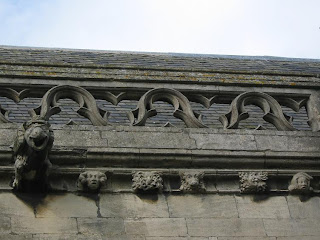
Frieze at Heckington (Lincs)

Frieze at Brant Broughton (Lincs)
Ancaster (Lincs)
Hawton (Notts)


North Muskham (Notts)
Hougham (Lincs)


Leasingham (Lincs)
Norton Disney (Lincs)


The other categories I mentioned above include bawdy and weird.  Firstly the bawdy and to Braunston in Rutland where you can see an ancient earth mother carving which could be over 1,000 years old.  It must have upset an incumbent priest at some time in history as it was turned over face down and used as a step into the church for several centuries before being rediscovered in the 1920’s.  Some people have classified it as a sheela na gig, a type of female figure exposing her genitalia, perhaps as a warning against lust, though many other theories exist.  Sheela na gigs occur all over the country, and especially in Ireland, but many were allegedly destroyed in the nineteenth century by outraged restorers.  Here’s one surviving example we found at Etton (near Peterborough), high up on the tower.

Earth mother at 
Brauston in Rutland
Sheela na gig at Etton (near Peterborough)


Now the rather explicit monster at Laxton (Notts), again displaying his all to the world at large.  It certainly raises the question as to how it could have been permitted but it has survived and we can only marvel at its audacity and enjoy it for what it is, and it is certainly different!

Finally in the saucy department, how about this lovely mermaid from All Saints Church in Stamford, a nautical theme in a place miles from the sea and a lovely survival in excellent condition?
Showing his all at Laxton!
Mermaid at All Saints, Stamford


And now onto the really weird category.  Firstly the head of an astonished man with a lizard crawling up his face from Wymondham church in Leicestershire.  What was the story?  One of the masons perhaps had fallen asleep outside only to be woken up by the lizard and then recorded by his fellow masons for posterity?
Lizard man at Wymondham (Leics)

Here’s another strange head, locally nicknamed Toothy, from Norwell in Notts.  (Yes I know we’ve shown him before but he’s worth another look…)  Anyway is he an exaggerated depiction of a local man or something much stranger?
"Toothy" at Norwell (Notts)
Strange beast at Little Casterton (Rutland)


And what sort of creature is this little chap we found in Little Casterton in Rutland, certainly lizard like from this angle?

Next here are a couple of pictures of a bench end carving from Westborough (Lincs) which depict a devil licking the backs of naked men apparently at prayer.  No doubt huge symbolism, but of what exactly?
Side view, Westborough bench end

Devil's tongue? Westborough (Lincs)


And finally a very strange carving from the tower at Ewerby, near Sleaford.  It looks like a monk (or nun) at prayer being attacked (or raped?)  It could perhaps be a warning for the devout to resist temptation by the devil, but another strange feature is that it projects horizontally from the tower.  Weird, really weird!


Attack at Ewerby (Lincs)
 To enlarge photographs just click on them.