Wednesday, 15 May 2013

Contrasts: Wartnaby and Owthorpe

Nether Broughton

Between Melton Mowbray and Bingham, an area at the edge of the Vale of Belvoir, there are many interesting and contrasting churches, some built of ironstone such as Nether Broughton and Long Clawson, some ashlar faced like Hickling, and others have been totally rebuilt at differing times, such as  at Kinoulton and Owthorpe.  None of these churches is without interest and many have churchyards full of C18 slate gravestones, characterised by beautiful lettering, endearing heart felt doggerel, and many headed with cartoon-like Belvoir angels.

Long Clawson

Kinoulton
Hickling

"Belvoir Angels" at Hickling

Wartnaby
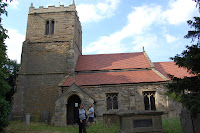
Less than two miles from Ab Kettleby within the fields lies the hamlet of Wartnaby with its quaint little church.  It is another ironstone church of golden brown colour, much eroded, approached through a field, with a pretty little bellcote.  Quaint and little it may be but Pevsner (1960) describes it as “impressive and important” and its importance lies in its surviving C13 painted decorations on its round arched south arcade and the fact that it appears to be untouched by Victorian restorers.  The decorations consist of mainly red painted motifs of intertwining flowers, foliage, and ribbons, certainly like nothing I’ve seen anywhere else.  Last year, like Ab Kettleby, the church was undergoing repairs but it is now open again for visitors and it is well worth a diversion off the main road. 

Wartnaby: Painted South Arcade
Wartnaby: C13 Foliage

A few miles up the A46 is Owthorpe, another hamlet a mile or so off the main road, again with a church built in a field.  But this church is completely different.  For a start it replaces a much earlier and bigger church destroyed in the Civil War, for Owthorpe was the ancestral home of Colonel John Hutchinson, the principled Parliamentary commander of Nottingham Castle and co-signatory of the death warrant of Charles I.  While he was deployed in Nottingham his manor house was attacked by Royalist troops and much of the village was destroyed.  This is covered in the detailed biography, still in print, of Colonel Hutchinson written by his wife, Lucy.  After the war Colonel Hutchinson returned to Owthorpe, rebuilt his house and the church. though the house was again raided by Royalists after the Restoration when Col. Hutchinson was arrested and imprisoned as a regicide.  The house itself survived until 1825 when it was destroyed by fire. 

Owthorpe
None of this turbulent history is evident in today’s peaceful hamlet.  A few humps and bumps in an adjacent field show where the manor house stood and no doubt there is much archaeology under the surface.  But what of the church?  When first seen it presents quite a strange shape with its rather dumpy tower, curving  western facade and almost domestic hipped roof.  Of the medieval church only parts of the north wall survive with a few fragments also built into the tower’s fabric.  Otherwise it is a simple rectangular room lit by southern windows built in a simple late C17 style.  Pevsner gives it a date of 1705.

Owthorpe: Atmospheric Interior
Inside one is struck immediately by the C17 painted screen which extends across the whole width of the church, said to have come from Owthorpe Hall, and also the C17 panelled pulpit.  However it is the number of memorials inside the church which gives the church its atmosphere, particularly the memorial to John Hutchinson himself with its inscription, said to have been written by his wife.  This refers to his being buried in a family vault beneath, though the monument is known to have been moved.  Also, it is said locally that Lucy Hutchinson herself is also buried in the vault, but buried upright.  Some excavations have been done in recent years around the church which have established that the vault does indeed exist.  What a pity that Time Team is no longer to continue; there surely would have been enough for several three day digs around Owthorpe so how about one of those special Time Team investigations?  Tony and Phil, it’s over to you.

Owthorpe: Part of the Inscription to Col. John Hutchinson

Monday, 15 April 2013

Ab Kettleby


Ab Kettleby St James in May 2012
8 April 2013, the first trip of the year.  Ab Kettleby.  It sounds like a station on a long closed rural branch line immortalised in a poem by John Betjeman.  Actually it’s a village of ironstone houses just north of Melton Mowbray, blessed with a lovely C13 spired church, described in the 1960 Pevsner as being “in a nicely decayed state”.  I don’t know what constitutes “nicely decayed” but the church has in fact been closed since 2006 having been declared unsafe and not so nicely decayed.  The parish was then faced with a tricky decision, either to close the church and let nature take its course or try to raise the money to save it.  They opted for the latter course and following a vigorous campaign, including a feature on BBC1's One Show and help from English Heritage, work on the church has now progressed to the point where Easter has just been celebrated in the church for the first time in years.  Well done to the campaigners!

Working on the spire in April 2013
There seems to be some mystery as to why the church had become so unstable.  Exploratory excavations have revealed that the church was built over a Roman villa site and an ancient ditch running north-south under the church may also have contributed to the problem.  Many ancient burials and inhumations were also discovered showing that the site has had a history of occupation and worship for many centuries before the present church was built.  Many church sites, and maybe most, have similar long histories but in many cases all remains are hidden below the church or all traces of previous occupation may have gone.  Whatever the cause of the problems at Ab Kettleby it looks as if the church will soon be back in use which really is an achievement to celebrate.

Ab Kettleby St James interior

 But we didn’t know that when we came to the church, out on our first trip this year.  I’d expected the church still to be closed but when we arrived the stone masons working on the church were on their lunch break in the back of the church and they were happy for us to come in and look around.  It must have been a welcome break for them inside the church as they were working that day high up on the spire and there was a vicious east wind outside, despite the bright sunlight.  They told us that they’d had to remove 10 courses from the top of the spire and then replace them after stabilising it.  That had followed extensive work on the C13 south aisle wall which had required substantial strengthening.  What a job it must have been but I hope that the church will now survive for many more centuries to come.

North arcade: C19 copy
 
South arcade: C13 capital


The church has a normal plan for one of its size with the C13 south aisle matched by a nicely executed north aisle built in the C19.  The chancel is also C13, perhaps an unusual survival when so many in the area were replaced in Victorian times.  Of special note is the tomb of Everard Digby of Holwell, who died in 1628, a relative of his namesake, Sir Everard Digby, one of the Gunpowder Plotters, who was executed in 1606.  Also to note are the C15 carved bench ends, some with curious faces, including one little man with his tongue sticking out.  How many times have we seen that in other churches?   


Everard Digby Memorial (1628)


C15 man with tongue sticking out


Another bearded man
And yet another!


 Another survival is the massive boiler by the London Warming Company.  I seem to remember a lot of these still in use in churches 50 years ago but they are quite a rarity these days so I hope it will be retained.  Despite its size and its industrial nature it has a certain beauty.  Another unusual feature is the C18 slate memorial to Thomas and Lucy Keal, not unusual in itself, particularly in this part of Leicestershire where there are many beautiful C18 Swithland slate memorials in local graveyards.  This one is unusual in its placing outside on the chancel wall below the east window.

Monumental Boiler - Not Many of These Left

Memorial to Thomas and Lucy Keal
 By the way the Ab in Ab Kettleby apparently derives from a long forgotten local tribal leader Abba so I hope you’ll note that I’ve resisted the temptation to weave in a lot of Abba song puns into this piece.  Maybe that’s just because I’ve got good taste or maybe it would have been different if some of those song titles had been more appropriate to the piece.  I guess we’ll never know…

For now let’s be thankful that the seemingly never ending winter weather looks like it’s finally retreated back to the Arctic.  Now we can get down to planning some more trips out in the country.

Friday, 15 March 2013

Memorials

The publication of a recent book about church memorials*, reviewed in The Times on 2 March 2013, has prompted us to take a closer look at the various memorials we have seen so far in the East Midlands. A number of these have already been mentioned, like those to Erasmus Darwin in the previous post and poet John Clare in our very first. This article brings together a few more, and some of the stories attached to the people involved.

First to Sempringham, in Lincolnshire, which once had a priory, the home of the English Saint Gilbert and his Order of Gilbertines. That association was the reason for our visit there in August 2011. The last thing we expected to see was a memorial to Gwenllian, the last Princess of Wales, who died in 1337.
 
 
Of course, we wanted to know the story behind this oddity. In 1282 King Edward I defeated and killed Gwenllian's father, the Prince of Wales Llewellyn ap Gruffydd, and so she stood to inherit the crown of Gwynnedd, as she had no brothers. In an act of political calculation, to head off future allegiances from her compatriots, Edward moved her away from her homeland to Sempringham, a remote location at the edge of the Lincolnshire fens. The Priory was later given £20 a year to care for her for what turned out to be 54 years. Gwenllian was in fact distantly related to Edward through an illegitimate line from King John. During her lifetime, the title of Prince of Wales was appropriated by the British crown and first given to Edward II (who was born in Caernarfon). Nonetheless, pilgrims now come to visit her memorial, which was erected in the 1990's.
 
If this was an unexpected find of historical significance, the memorial to William Cecil, first Baron Burghley, was entirely what we might have expected of Queen Elizabeth I's Secretary of State from 1558 and Lord High Treasurer from 1572 to his death in 1598. His alabaster and marble tomb in St Martin's church in Stamford is a magnificent object.
Dressed in ermine, painted in gold and crimson and clutching his staff of office, he looks every inch the most powerful man in England.
He was born in Bourne in Lincolnshire in 1520 and completed Burghley House in 1587 on land just outside Stamford that he inherited from his father. His dynasty includes the Earls of Exeter and Salisbury. Memorials to some of his descendants are included in the Burghley Chapel in St Martins.


 Also included in the Chapel is a plaque to the memory of Benjamin Disraeli, which reads:
Late Prime Minister. The intrepid leader of the Conservative Party, the patriotic servant of his country and a true and valued friend at Burghley House. Born Dec 21, 1804. Died April 19 1881. Peace with Honour. 

Alabaster monuments have a particular importance in the East Midlands, as the main source of supply of alabaster in the middle ages was Nottinghamshire, Derbyshire and Staffordshire. In fact, Nottingham was famous across Europe as a centre for alabaster carving. This may explain why we have seen so many. While few are as lavish as Willaim Cecil's, some run him close and allow us to appreciate alabaster as a material in its natural, unadorned state.


The monument to Charles Noel in St Peter's, Brooke in Rutland is particularly fine, although it is the tomb itself rather than the effigy that retains its original paintwork. Charles, who died in 1619 at the age of 28, was the second son of Andrew Noel, courtier to Elizabeth I and the builder of the family mansion at Brooke. Charles was unmarried but the family were ancestors to future Earls of Gainsborough and Viscounts Campden. They acquired Exton Hall through marriage and the church there, just across Rutland Water, houses further very fine monuments, one of which can be seen in our post on Celebrity Churchcrawlers of 7 March 2012.

The monument to Richard Whalley of Screveton, in Nottinghamshire, who died in 1583, was mentioned in the previous post. It is worth another photo just to show off the fine alabaster and appreciate the joke in having a whale as the family emblem. A whale adorns the head and foot of the effigy and that at the foot is quite naturalistic, despite looking more like a fish than a whale! Although Richard had 25 children with 3 wives, a plaque on the memorial indicates that the family died out in 1690.


The grandest monuments tend to be to the very rich. One of the richest was Sir Gilbert Heathcote, from a Derbyshire family in the 17th Century, who made his fortune as a London merchant and became both the Lord Mayor of London and the Governor of the Bank of England. He invested his wealth in buying an estate in Rutland and lived out his days there in Normanton Hall, later the home of his descendants, the Earls of Ancaster. In the 1970s, the village and site of the Hall, gutted by fire in 1925, were covered by Rutland Water, although the stable block survives as the Normanton Hall hotel. The top of Normanton's Georgian church of St Matthew can still be seen at the water's edge, serving as a museum. Sir Gilbert's memorial is in the St. Mary the Virgin church at nearby Edith Weston.
 
The aristocracy and the rich did not have all the monuments to themselves. The Lincolnshire church of Aswarby serves to remind us of a wider social spectrum and not only of the country's history but of international discovery. Walking into the nave  we wondered why the Australian flag was flying from the roof. A nearby memorial made all clear.
 
George Bass went to school in Boston, was admitted to the Company of Surgeons in London at the age of 18 and joined the Royal Navy in 1794. While his career was illustrious, he died in mysterious circumstances, setting off from Sydney in 1803 for Tahiti and Chile, never to be seen again.

Finally, the memorial to Mary Lister, who died in 1734 in Coleby, Lincolnshire, provides an insight into the social conventions of the 18th Century, especially the place of women. Memorials to women, other than as wives in family tombs, are quite rare. Mary Lister was from a landed family and funds were clearly availble  to record for posterity that she was:
A woman of very good sense,
Submissive and condescending to her superiors,
Affable and courteous to her equals,
Easy and humourous to her inferiors,
Agreeable and obliging to all.
 
The churches in which these monuments can be seen are shown below. Click on any picture to enlarge it.


Aswarby


Coleby


Screveton
Edith Weston


St Martin, Stamford
Brooke


Sempringham


*Remembered Lives: Personal Memorials in Churches, by David Meara and Lida Cardozo Kindersley, Cambridge University Press, January 2013


Tuesday, 13 November 2012

Newark Area Churches, Part Two


All Saints, Elston
Back to our A46 trip on a lovely summer’s day in August.  The next church we visited was at Elston, a village with, surprisingly, two medieval churches.  The parish church, another one dedicated to All Saints, has rather strange proportions with a slender tower which looks rather too high for the church below it, quite the reverse of the church at East Stoke.  But it is another church packed with interest, particularly the many monuments to the Darwin family from Elston Hall including Erasmus Darwin, physician, scientist and poet, and grandfather of Charles Darwin.


Charles Darwin's Grandfather

Elston Chapel: Georgian Interior
In fields east of the village lies Elston Chapel, a simple almost domestic looking medieval building from the outside (see photo in the October blog, "Getting there and getting in"). Inside though it has the original Georgian pews, pulpit and wall paintings and you get something of the sense of what many small churches must have been like before Victorian restorers did their work.  Now redundant and like nearby Cotham the Chapel is in the care of the Churches Conservation Trust.  Both churches are kept open and both, interestingly, have old graffiti around the entrance doorway

Syerston
 Syerston is the next village down the A46.  It has a rather plain long church, without either aisles or clerestory.  However when we visited the porch was surmounted by a very attractive garland of flowers left over from a recent wedding.  It is normally locked but the keyholder is nearby; unfortunately though not at home when we visited.


Wedding Garland at Syerston

Flintham
St Augustine, Flintham, has a rather unusual layout with a central tower, a rather plain early C19 nave and much earlier chancel.  Evidence of early herringbone masonry in the lower part of the tower and on its south side a filled in arch where a transept or south aisle may have been attached.  Inside an early monument to a crusader, possibly Sir John Hose.


Flintham Crusader
Sibthorpe
 Sibthorpe was next, formerly a collegiate church now much reduced with both north and south aisles removed.  Now, following repairs and restoration in the C17, C19, and more recently, it now appears plain and neat on the outside with simple C19 windows on the south side and original windows reset on the north side.  Inside, however, there are more riches, with yet another Easter sepulchre, not as grand as at Hawton and an elaborate alabaster tomb of 1590 to Edward Burnell.  In an adjacent field is a Gr 1 listed C13 or C14 dovecote, the only building related to the former collegiate foundation that survives.  
Sibthorpe Easter Sepulchre

Sibthorpe: Monument to Edward Burnell


Sibthorpe Dovecote
Krys from Krakow


It was at Sibthorpe that we first met up with a Polish church crawler, Krys from Krakow, who was cycling round that day like us visiting local village churches.  He followed us round for the rest of our trip proving that touring churches by bike was really the way we should have been travelling.  Next summer maybe. Incidentally, Krys was one of several church crawlers from Europe that we came across this summer.
 

Hawksworth
The next church was at Hawksworth, unfortunately locked.  Hawksworth is again a small village with quite a large church, unusually with a brick tower from the C17, with much of the exterior fabric of the nave and chancel dating from various C19 restorations.  The distinguishing feature of the church, however, is the C11 tympanum now set in the south wall of the tower depicting the Adoration of the Cross with an inscription in Latin that translates roughly as “Gauterus and his wife Cecilina have caused this church to be made to honour our Lord, the Virgin Mary and all saints of God as well”.  It’s a long time since I did O Level Latin and I really must try to swot up over the winter as we often find Latin inscriptions, even in the smallest of rural churches.


Hawksworth Tympanum
  
Screveton in the afternoon sun
The last church of the day was Screveton.  As we arrived the grass in the churchyard was being cut and the late afternoon sun was very pleasant.  And it was nice to see a village church with red tiles for a change.  Inside there are several points of interest particularly a lovely C12 font and tucked away in the lower tower chamber a massive alabaster monument dated 1583 to Sir Richard Whalley, his three wives and 25 children.  The monument must have stood in a more prominent place in the church at one time but maybe it was moved temporarily while restoration took place but once moved the cost of moving it back may have been considered too much?  Or perhaps it was just in the way?  Just a thought.


Screveton C12 Font

Monument to Sir Richard Whalley and his many children
  
So many wonderful churches, so little time.  We visited 90 this year.  Looking forward to next year’s 90!